Clear View Project


Buddhist-Based Resources for Relief and Social Change

The International Network
of Engaged Buddhists
INEB

0 00243580889United0243580889

 ___________________________


The 2011 Bi-Annual Conference of the

International Network of Engaged Buddhists (INEB)

The Future of Buddhism:

From Personal Awakening to Global Transformation

Venue: Wat Pa-Buddhagaya

Bodhgaya, India

October 26-29, 2011


For registration and for more information, please contact the INEB Secretariat

www.inebnetwork.org


_________________________


A BRIEF REPORT FROM THE 2009 INEB CONFERENCE

The International Network of Engaged Buddhists (INEB) was created in 1989 by Thai social activist and writer Sulak Sivaraksa and a small circle of like-minded friends — kalyanamitta  — in Asia and the West. I have been attending INEB conferences — first annually then bi-annually — for the last eighteen years, and this expanding circle of spiritual friends has been an essential source of support and education for me, and a venue for Buddhist action in Asia.

Our resources have always been limited — one more or less fulltime staff person and a small office — so INEB has, of necessity, functioned as a network. The conferences, beyond the presentations and plenaries, allow people to meet and develop ideas for local, national, regional, and topical programs that operate independent of INEB’s direct coordination. In the past this has led to training for women’s empowerment, support for environmental action by Thai monks, collaboration with ex-untouchable Buddhists in India, witness delegations to Burma, Bangladesh, and Cambodia, and many more grassroots activities.  INEB's Think Sangha (about which more later) evolved in the 1990s from a group looking at the need for Buddhist social analysis. While networks and projects may be ephemeral, the relationships among us endure.

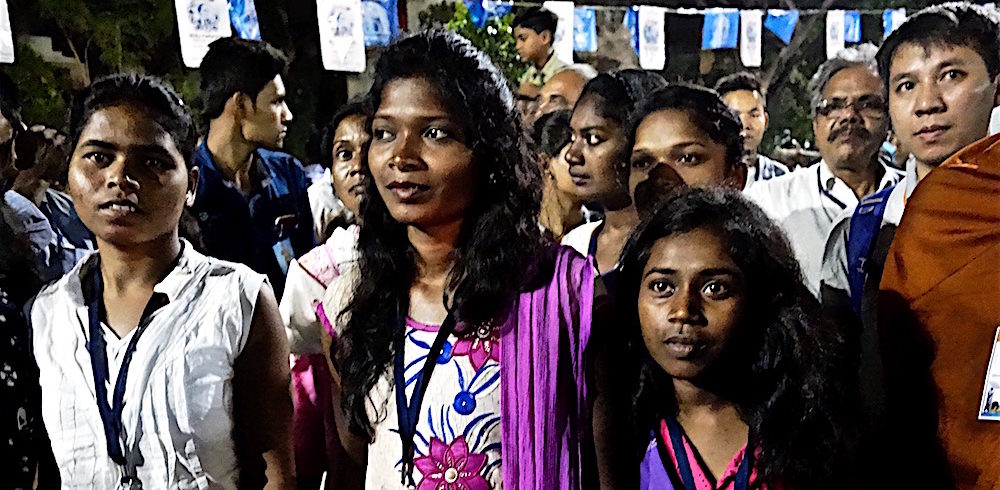
This year’s conference, INEB’s 20th anniversary, was organized in and around Chiang Mai in the north of Thailand. Over the course of a week’s activities — including a three-day meditation retreat led by Dharmachari Lokamitra from Friends of the Western Buddhist Order and Trailokya Bauddha Mahasangha Sahayaka Gana (TBMSG) , the conference itself, talks and cultural evenings at Wat Suan Dok, an international alms round collecting money and medicine for Burmese refugees, a day-long festival of engaged Buddhism, and an evening peace walk through the crowded streets of Chiang Mai — more than two hundred people, lay and monastic, took part.  By my count there were representatives from Thailand, Burma, Vietnam, Cambodia, Laos, Indonesia, Malaysia, Japan, Korea, Taiwan, Sri Lanka, Bangladesh, India, Bhutan, Nepal, Ladakh, Tibet, Europe, South Africa, Australia, and the U.S.

Aside from the heat — it was in the nineties for my first four or five days in Thailand — in the midst of great busyness some vivid points come to mind.

• The strong presence of youth and the promise of generational continuity. There were articulate and dedicated young people in almost every Asian delegation.  Tempel Smith, with whom I worked at BPF, brought a group of eight youth from the U.S., at the start of a six-month Asian immersion Tempel has organized.

• Large and active participation from a number of countries — Burma, Sri Lanka, India, Japan, and more — which allowed for the creation of national and regional working groups following up from the conference.

• The leadership and visibility of women in virtually every aspect of planning and presentation.  Looking back over my years in INEB, though patriarchy has not completely disappeared, this seems to me something we are getting right.

• The return of many old friends for this 20th anniversary, some of whom had been apart from the network for ten years or more.

I am grateful to the conference organizers for several opportunities I was given to present and share ideas.  At the conference plenary, Ven. Dhammananda, the formidable Thai bhikkhuni, and I spoke about our experience and vision of engaged Buddhist community and organization. I helped my old friend Ouyporn Khuankaew explore issues of gender. On the last day I took part in an interfaith panel —Buddhist, Christian, Muslim — looking at spiritual practices that support our respective social action.

In the Upaddha Sutta the Buddha explains to Ananda that kalyanamittata, spiritual friendship, is the all of the holy life. This understanding is at the heart of INEB. Over all these years friendship is the mysterious force that draws me across the ocean again and again.  Maybe it is not, at last, so mysterious. “Only connect” — this is the watchword of sentient beings.  We yearn for connection on the deepest biological level, and then, laboring in delusion, we build walls of self, race, gender, nation, and so on to protect ourselves from the responsibilities that come with connection. If we remember “only connect” and cultivate connection as we strive to do at INEB, then the suffering and joy of our many lives becomes our common human treasure.

I include below the statement read at Chiang Mai’s ancient Tha Pae gate, at the end of our peace walk.


INEB CONFERENCE STATEMENT

This week in Chiang Mai the International Network of Engaged Buddhists celebrated its 20th anniversary with a successful conference dedicated to peace and social transformation. As kalyanamitta, more than two hundred socially engaged Buddhists from twenty-five countries – from Asia and the Pacific region, from North America and Europe – joined together for study, dialogue, and dharma practice, committing ourselves to work for peace.

We affirm our deep belief that the suffering of society – war, racism, poverty, gender oppression, destruction of the environment, and cultural degradation – can be transformed into liberation for all beings.

We affirm and have seen ourselves that peace can arise from even the fiercest of conflicts.

Together we confronted critical concerns that affect life on this precious and fragile planet:
                                                
     • the intertwined disasters of consumerism and environmental destruction;
     • the vital need to empower and educate young people;
     • the pervasive oppression of women, and all gay-lesbian-bisexual-transgendered men & women;   
     • the denial of human rights and meaningful livelihood;
     • the need to preserve Buddhism and all traditional culture and religion;
     • and the obscenity of war, civil strife, and violence.

These concerns, wherever they arise in the world are our concerns.  They are close to our hearts. In the Buddha's way and in the way of every great religion, we know that we must meet this suffering not with faith alone, but with all our efforts and action day by day.

— 17 November 2009      


Web Hosting powered by Network Solutions®


Home

Clear View Blog

Bodhisattva's Embrace etc

About Us

Safe Harbor-Ethics

Fundraising & Donations

Burma/Adopt a Monk

Letter to Obama on Burma

Adopt a Monk

Training, Burma Jan 09

Burma -history/background

Burma -Saffron Revolution

Jarvis Masters/Death Row

India—Buddhism Rising

INEB

Engaged Buddhist Writing

Remembering Robert Aitken

What About the Elections

Four Founders of SEB

Columbia 68 Strike Redux

Sticky Privilege

Practical Zen Psychology

Alan's Music

Contact Us

Links